Early-stage evidence-bound systems architecture
Latticra
A contract-first architecture for making requests, capabilities, policy boundaries, runtime posture, and evidence records explicit before authority is granted.
- Status
- Early-stage foundation
- Runtime posture
- No-effect by default
- Status record
- May 27, 2026 CDT
Choose a Path
Start with the question you have.
Latticra's public record set is dense by design. These routes keep the first click purposeful: current posture, safe local review, system shape, security boundaries, validation evidence, or the source map.
Status
I need the current posture.
Read the estimates, active lanes, latest posture notes, and public non-claims before trusting any other surface.
Open route
Start
I am new to Latticra.
Use the no-effect first-run path for status review, local checks, and safe expectations.
Open route
Architecture
I want the system shape.
Follow the layers, authority boundaries, evidence flow, and runtime posture without jumping into raw records.
Open route
Security
I am checking safety claims.
Review security policy, testing rules, default-deny language, and the claims Latticra does not make yet.
Open route
Validation
I need local evidence.
Inspect Panel install evidence, package guards, disposable VM gates, and no-effect dry-run contracts.
Open route
Map
I need exact source records.
Use the documentation map to move from public pages into contracts, status records, and validation sources.
Open route
Orientation
Built around claims that can be inspected.
Latticra treats architecture as an evidence trail. The repository separates contracts, metadata, reports, guard scripts, implementation slices, and non-claims so readers can see what exists now and what still requires proof.
What Latticra is
- An evidence-bound systems substrate for Linux-era and AI-era computing.
- A public engineering record for explicit authority, request, capability, and runtime boundaries.
- A collection of no-effect C, constrained C++, Rust installer, shell guard, and documentation lanes.
What Latticra does not claim
- No production runtime, hardened sandbox, certified security boundary, or operating-system replacement.
- No unrestricted command execution, network authority, root installer, Fedora approval, or Ubuntu archive readiness.
- No active AI-agent execution control or production cryptographic key authority.
First Source Records
Jump from public summary copy to exact repository evidence.
If you need to verify homepage wording quickly, start with the current status record, the non-claims boundary, and the foundation or documentation authority records that govern the public mirrors.
Fastest Proof Path
Status, then boundary, then index.
Read the May 28, 2026 CDT current status record, confirm the blocked claims, then branch into the foundation and traceability records.
Public-Site Rule
HTML pages do not replace source records.
The public pages summarize posture, but the Markdown records remain the authority for claims, dates, validation, and exact scope.
Best Use
Open one lane with its governing records.
Use these links before trusting subsystem, security, packaging, runtime, or AI-adjacent wording beyond the public overview pages.
Status Record
Current Status
Detailed public posture, current estimates, evidence notes, and the latest dated status context.
Boundary
Non-Claims
Explicit limits on operating-system, installer, security, network, and production-readiness claims.
Wording Guard
Public Claims Ledger
Allowed public wording, blocked wording, and the proof required before claim promotion.
Foundation
Foundation Index
Main index into contracts, strategy records, implementation documents, status records, and guards.
Reader Route
Documentation Reader Journey Map
Audience-specific start points, success criteria, and stop signals for public-site readers and reviewers.
Traceability
Documentation Traceability Matrix
Crosswalk from public pages to source records, validation paths, and nearby non-claim boundaries.
Architecture
Named layers, conservative posture.
The current system emphasizes declaration, classification, metadata, and deterministic reports before operational behavior. Each lane has a role and a boundary.
Contract language direction
Parsing, validation, diagnostics, and metadata lowering for system declarations.
Bounded representation
Graph-shape and metadata reporting without LIR execution.
Operator-visible surface
Declaration and report rendering foundations before terminal-control behavior.
Task-boundary records
Coordination and task classification under report-only, denied-by-default posture.
Before operational behavior
Disabled-by-default classification and report surfaces before runtime authority.
Trust and tool boundaries
Request freshness, signed-request, policy-decision, capability-gate, and dry-run metadata.
Local workbench
User-local installer and evidence review path with no root and no network authority by default.
Validation lane
Ubuntu build/local deb and Fedora disposable VM/local RPM evidence paths, not distribution readiness.
Evidence Path
Promotion requires more than intent.
Latticra uses a staged evidence model: define the boundary, produce deterministic records, keep effects denied, then promote only when tests and status records support the claim.
-
01
Contract
Name the capability, prerequisites, limits, and explicit non-claims.
-
02
Metadata
Represent the request, policy, capability, and report fields in bounded structures.
-
03
Guard
Run deterministic scripts and tests that preserve no-effect behavior.
-
04
Status
Record the exact posture so public entry points do not overstate readiness.
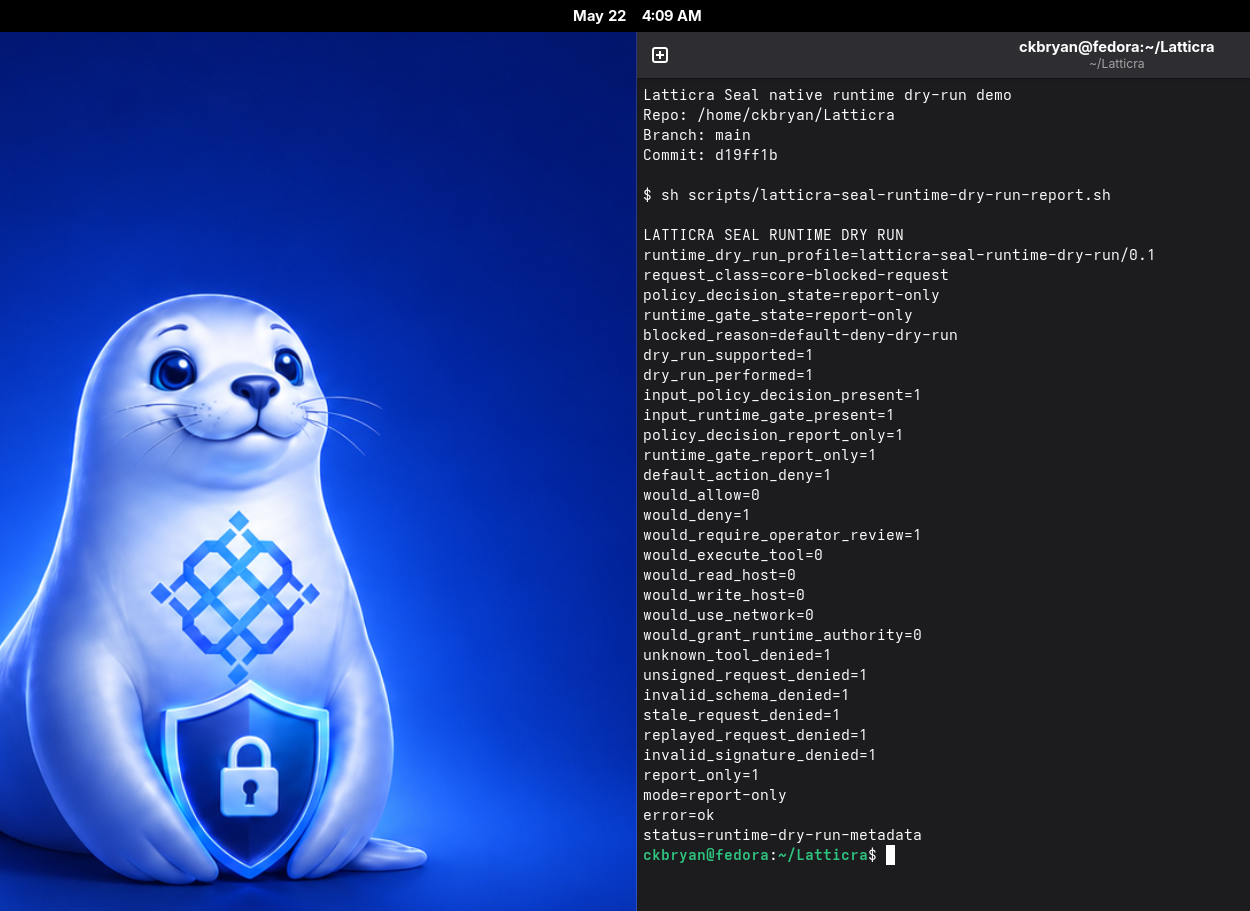
Latticra Seal
Report-only tool-boundary planning for AI-era automation.
Latticra Seal records what would be denied, why it would be denied, and which evidence supports the decision. Unknown tools, unsigned requests, stale requests, replayed requests, invalid schemas, and missing authority remain blocked cases.
report-only
default-deny
operator review
Start Locally
Read the status first, then run no-effect checks.
The repository is designed to be inspected from the public records outward. The commands below mirror the current no-effect posture rather than promising operational authority.
Read the public posture
sed -n '1,220p' STATUS.md
sed -n '1,260p' docs/status/CURRENT_STATUS.md
Run broad safety guards
make quality
make seal
Inspect the no-effect CLI
mkdir -p build
cc -std=c99 -Wall -Wextra -pedantic src/latticra_cli.c -o build/latticra
./build/latticra --status
Resources
The important records, grouped for fast entry.
These links are the best first paths through the repository: general orientation, current status, foundation contracts, subsystem documentation, and safety policy.
Primary Pages
Start with the HTML route.
Status, Start, Architecture, Security, Validation, and Map are the fastest reader paths.
Source Records
Then inspect exact files.
Markdown records remain the source for contracts, status, evidence, and public copy rules.
Safety Gates
Promotion stays evidence-bound.
Security, release, packaging, and runtime wording stays narrow until reproducible proof exists.
01
Language
Lat, LIR, and L-UI
The no-effect parse, validate, lower, and report lane for Latticra declarations.
Subsystem
Latticra Seal
Tool-boundary, policy-boundary, dry-run, blocked-case, and evidence records.
Evidence
Claims and Evidence
The evidence ladder, promotion rules, non-claims, and source records.
Concept overview
Start here when you need the public explanation before opening source records.
02
Product Docs
Product Documentation Cohesion
Reader routes, product-surface responsibilities, safe copy rules, and cross-link expectations.
Glossary
Documentation Glossary
Shared public terms for evidence, validation, posture, platforms, readers, and product readiness.
Readers
Documentation Reader Journey Map
Audience-specific routes, success criteria, stop signals, and friction checks.
Authority
Documentation Source Authority Order
Which source records, status records, non-claims, mirrors, and review packets win when docs disagree.
Freshness
Documentation Freshness Lifecycle Policy
Lifecycle states, stale-review handling, supersession blocks, and date review rules.
Impact
Documentation Change Impact Radius Guide
Review-radius rules for local edits, source records, mirrors, validation paths, status, and public pages.
Status Docs
Documentation Status Record Standard
Status-record shape, index entries, public mirrors, evidence, validation, non-claims, and boundaries.
Commands
Documentation Command Example Standard
Runnable snippet rules for prerequisites, effect boundaries, expected output, cleanup, and blocked claims.
Visuals
Documentation Visual Asset Standard
Screenshot, diagram, public image, alt-text, source context, freshness, and visual non-claim rules.
Health
Documentation Health Scorecard
Rubric for findability, claim safety, traceability, validation, reader routes, and public/source consistency.
Subsystems
Subsystem Documentation Standard
Required posture, evidence spine, validation, non-claims, stop signals, and mirror rules for subsystem pages.
Public Site
Public Site Mirror Standard
Static HTML mirror rules for source Markdown alignment, links, estimates, validation, and non-claims.
Traceability
Documentation Traceability Matrix
Public surfaces mapped to source records, validation, mirrors, and non-claim boundaries.
Validation
Documentation Validation Playbook
Validation levels, guard selection, link checks, and documentation failure handling.
Drift
Documentation Drift Response
How to narrow, align, demote, and block unsupported public wording.
Style
Documentation Style Guide
Canonical project terms, status/date style, headings, links, and replacement wording.
Claims
Public Claims Ledger
Allowed wording, blocked wording, and proof required before public claim promotion.
Documentation operating rules
Use these records to check wording, freshness, traceability, status mirrors, and claim boundaries.
03
First Run
Getting Started
A no-effect reader path for status review, local checks, and safe expectations.
Architecture
System Architecture
A guided view of layers, authority boundaries, evidence flow, and no-effect posture.
Kernel
Kernel and State Lattice
Compiled C kernel identity, lifecycle reports, subsystem summaries, and denied external effects.
Boot
Boot Preview Boundary
SeaBIOS/GRUB compatibility, fixture-only boot-preview evidence, preflight, and blocked boot claims.
Runtime
Runtime Boundary
Disabled-by-default runtime classification, Nucleus task reports, and policy matrix metadata.
Examples
Local Checks
Concrete no-effect examples for L-UI fixtures, parser reports, and language guards.
Status Dashboard
Public Status
A scannable dashboard for current estimates, posture, workstreams, and non-claims.
Direction
Roadmap
Sequencing principles, planning estimates, active lanes, and guarded next steps.
Reader routes
Guided HTML pages for onboarding, current posture, architecture, examples, and roadmap context.
04
Workbench
Console, Panel, and Nadia
Guided local install, metadata-only console, and offline AI planning posture.
Panel
Latticra Panel
Guided GUI workbench, dry-run-first install flow, receipts, updater, and user-local evidence.
Console
Latticra Console
Stage-0 LC identity, registry-backed commands, Panel profiles, host contracts, and receipt planning.
Offline AI
Nadia
Stage-40 contract-only AI planning with no model runtime, inference, tools, or network authority.
Validation
Local Install Evidence
Panel install evidence, package guards, disposable VM gates, and no-effect dry-run contracts.
Installer
Readiness Boundary
Disposable VM CLI payload evidence, artifact manifest fixture, production gates, and blocked release claims.
Packaging
Platform Readiness
Fedora, Ubuntu, openSUSE, Debian, BSD, and macOS package-shape lanes without release claims.
Navigation
Documentation Map
A guided path through status, contracts, architecture, subsystems, and local validation records.
Workbench, validation, and release boundaries
Local workflow, installer, packaging, and validation pages that stay dry-run or evidence-only until promotion gates pass.
05
Project Overview
Root README
Small public front door with quick routes, current work areas, and public non-claims.
Current State
Status
High-level project posture and completion estimate summary.
Detailed Status
Current Status
Detailed progress rollup, latest notes, and next-priority context.
Foundation
Foundation Index
Contracts, strategy records, implementation documents, and guard scripts.
Handbook
System Substrate
Main project book and substrate documentation entry point.
Presentation
Academic Presentation
Colorado Technical University Latticra Substrate theorem presentation.
Reference
Reference Manual
Generated v0.1.0 book package with PDF, editable Markdown, and source manifest.
Source records and books
Repository records, status files, foundation indexes, and generated reference materials behind the public pages.
06
Safety
Security Policy
Safe testing rules, vulnerability reporting, and security non-claims.
Supply Chain
Release Authority Gates
CI, dependency, SBOM, updater, runtime-authority, and release non-claims.
Updater
Signed Delivery Gate
Closed signed-updater gate, local-checkout policy, denial transcript, fixtures, and no network self-update authority.
Cryptography
Assurance and Key Management
FIPS/CMVP claim gates, key lifecycle, randomness, Seal metadata, and no production crypto claims.
Identity
Access Management Baseline
Privileged access, phishing-resistant MFA planning, account lifecycle, service identity, and hosted-access non-claims.
Logging
Monitoring and Detection Gate
Event-source inventory, audit events, redaction, retention, triage, and no SIEM or detection-service claims.
Recovery
Backup and Resilience Gate
Backup scope, restore testing, RTO/RPO, rollback planning, and no recovery-service or failover claims.
Configuration
Change Management Gate
Configuration inventory, secure baselines, approved changes, drift planning, and no hardening or enforcement claims.
Network
Exposure and Remote Access Gate
Network inventory, internet exposure, ingress/egress policy, remote access, RMM, DNS/TLS lifecycle, and no network-service claims.
Data
Classification and Protection Gate
Data inventory, sensitive-data flows, PII review, minimization, retention, redaction, and no customer-data claims.
Incident Response
Reporting Boundary
Reporting routes, evidence preservation, response gates, and incident-response non-claims.
Vulnerability Management
Release Gate
KEV/NVD review, disclosure paths, exception records, and product-security non-claims.
Security and assurance gates
Baseline pages for security policy, supply chain, cryptography, access, logging, recovery, change control, exposure, data, incidents, and vulnerability review.