Manifest scope
Declare what Seal may inspect and which paths or authority claims remain outside scope.
Report-Only Evidence Boundary
Seal is Latticra's local verification and policy-boundary layer. It records evidence, denials, report-only dry runs, and non-authority posture before runtime enforcement can be claimed.
Current Role
Seal begins with bounded evidence: manifests, hash baselines, policy checks, and deterministic reports. It is not a production security product, sandbox, root installer, kernel layer, network authority, or runtime enforcement authority.
Declare what Seal may inspect and which paths or authority claims remain outside scope.
Compare local evidence against lock material and report changed, missing, or new records.
Fail closed for malformed input, unsupported authority, denied paths, or unsafe assumptions.
Emit human-readable local evidence with mode, status, warnings, failures, and authority flags.
Prepare metadata for future runtime-boundary work without granting runtime authority now.
Dry-Run Posture
The current dry-run report surface renders default-deny metadata for blocked requests. It does not execute tools, read or write host files, use the network, verify signatures, or grant runtime authority.
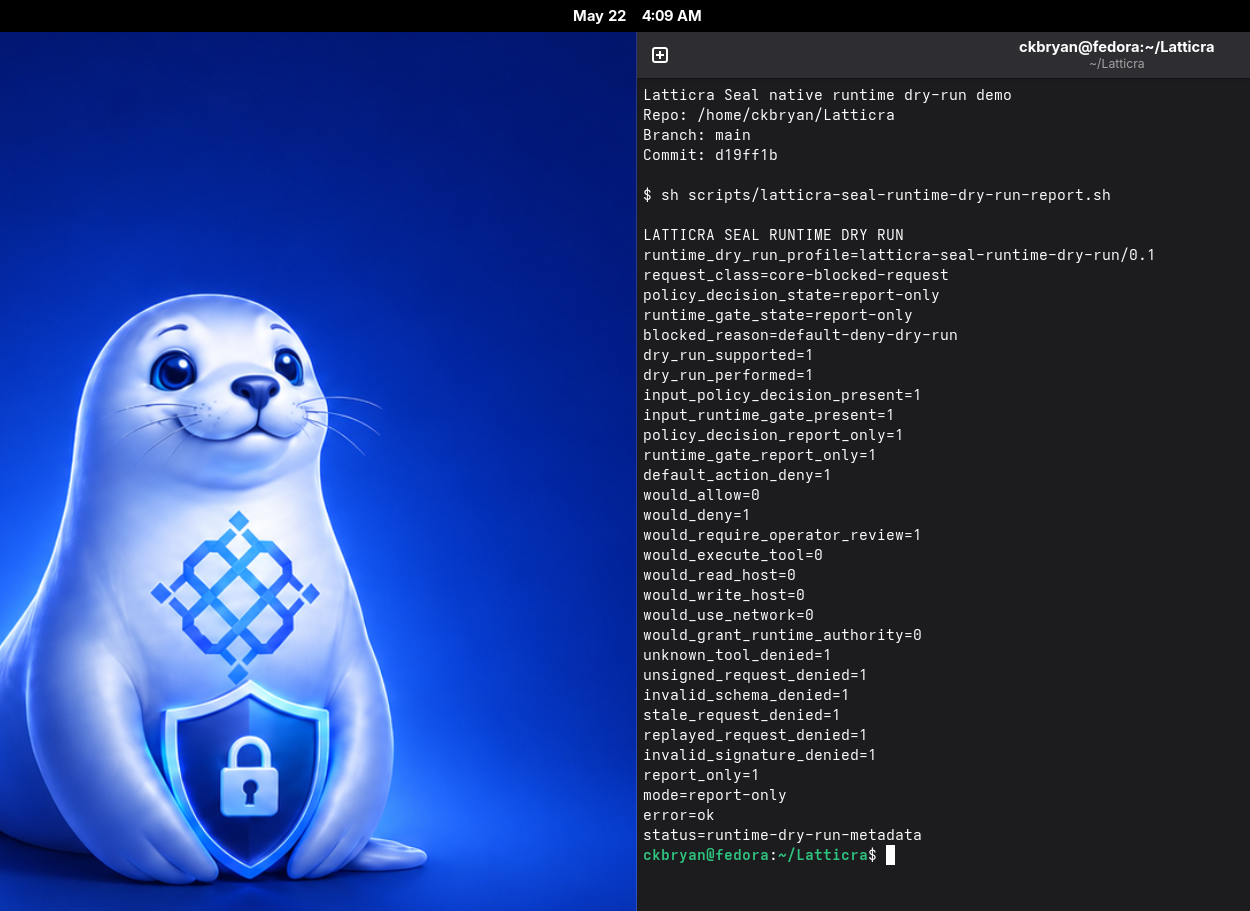
Report Fields
These values keep the public posture narrow: a denied dry-run is evidence of refusal, not proof of host security.
Blocked Cases
Seal's current blocked-request vocabulary is explicit so readers can tell which negative cases are represented.
Unsupported tools remain denied instead of guessed or auto-approved.
Missing request signature metadata remains a blocked case.
Malformed or unsupported parameter shape fails closed.
Freshness failures remain denied in the metadata path.
Replay-class cases remain blocked without mutating a live replay cache.
Invalid signature metadata stays denied without claiming production verification.
Authority Boundary
A passing Seal check means the checked evidence matched the declared local expectations for that command. It does not mean production security, malware prevention, runtime isolation, kernel enforcement, or certification.
Local reports, manifest/hash baseline, policy regression, blocked-case metadata, and dry-run report surface.
Network authority, runtime enforcement authority, root authority, host mutation, tool execution, and production-security claims.
Runtime enforcement can be considered only after implementation, status alignment, negative-case evidence, and guarded tests exist.
Local Checks
These commands are local evidence checks. They do not grant root, network, runtime, or host-protection authority.
make seal
sh scripts/test-latticra-seal-report.shmake seal-policy-denials
sh scripts/test-latticra-seal-policy-decision.shsh scripts/latticra-seal-runtime-dry-run-report.sh
sh scripts/test-latticra-seal-runtime-dry-run-report-surface.shSource Records